Totale besoekerstal
- Artikels vertoon Trefslae
- 9959392
Besoekers aanlyn
Ons het 77 gaste en geen lede aanlyn
|
|

Teken aan
Media
THABO MBEKI, JACOB ZUMA, SAM NUJOMA, IN WIE SE DIENS?
| |  |
|  | Trefslae: 3389
| | Trefslae: 3389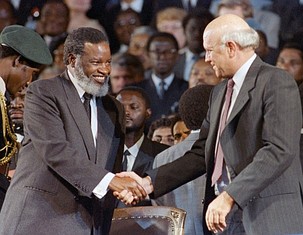 My constant question is: what did Nujoma do for the Boers to deserve such treatment?
In adv. Piet Pretorius se boek, Volksverraad... Waarom? voer hy aan dat Thabo Mbeki en Jacob Zuma albei poppe van die ou inligtingdienste van Suid-Afrika (die inligtingsdienste onder Afrikaner-bewind) was. Dat so 'n toedrag van sake baie voordelig vir die Afikanervolk kan wees, ly geen twyfel nie. Immers is sulke mense willose poppe na die smaak van die hanteerder, of hoe..? Die vraag is egter of sulke mense maar altoos poppe in die hande van die hanteerders bly.
Dit lyk in elk geval of die binnekring van die kommunistiese ANC Mbeki se dubbele rol weldrae besef en hom vervang het met Zuma ten einde die Suid-Afrikaanse Rewolusie weer met Zuma se hulp op koers te kry.
As adv. Pretorius se verduideliking aanvaar word – dat Zuma maar ook 'n pop van die inligtingsdienste was – is die afleiding nie verkeerd nie dat die Suid-Afrikaanse Rewolusie maar net nog 'n slag in die hande van iemand beland het wat die rewolusie bestuur en uitvoer ten behoewe van mense en instansies agter Zuma.
Adv. Pretorius verstrek baie goeie redes in sy boeke (Volksverraad en Volksverraad... Waarom?) waarom aanvaar kan word dat mnr. John Vorster 'n pion in die hande van die buiteland en in besonder die Amerikaanse inligtingsdiens, die CIA, was.
Dit is dus verstandig vir die Afrikanervolk om die vermoede te handhaaf dat waar mnr. Vorster ook al as politieke ampsdraer van die ou Nasionale Party betrokke was, die uitvoering van die Suid-Afrikaanse Rewolusie volgens die resep van die CIA in die oog gehou word.
Die ou Sowjet-Unie as hoofbedrywer van die Suid-Afrikaanse Rewolusie (of moet dit eerder die Suidér-Afrikaanse Rewolusie genoem word, het al aan die einde van die 1990's van die toneel verdwyn (ook as mnr. FW de Klerk geglo word!).
Nog net die CIA het oorgebly.
Nou tref dit dat mnr. Vorster in die vroeë jare 1960's die NP-regering se minister van polisie was. Die land se inligtingsdienste het toe onder 'n ander naam/name bekend gestaan, u sal die name sien in die berig wat aanstons aangebied word.
Wanneer u die berig lees kan u maar in gedagte hou watter verskonings iemand soos Vorster vertroulik kan aanbied wanneer daar beswaar is dat sy dade en onderhandelinge eintlik maar lei tot oorgawe aan kommunistiese magte, mnr. Vorster se verskonings iets soos: “Moet u nie bekommer nie! Sam Nujoma is eintlik maar ons man!”
Maar wat mnr. Vorster nie sou gedoen het in so 'n bekentenis nie, is dat hy wat mnr. Vorster is, en ook sy hoofspioen genl. Langhendrik van den Bergh, eintlik maar die CIA, die langtermyn bedrywers van die Suider-Afrikaane Rewolusie, se manne, of poppe dan, was.
Daarom dalk net 'n vermaning as iemand, dalk 'n lid van die ou Suid-Afrikaanse inligtingsdienste, of 'n lid van die Verligte Aksiegroep, die elite-groep binne die Broederbond en die voormalige Nasionale Party wat die rewolusie ten behoewe van die CIA bedryf, aan u vertroulik vertel u moet u nie bekommer nie, Jacob Zuma is eintlik “ons” man: Zuma is nie “ons” man nie, hy is inderdaad die CIA se man.
Hier volg nou die berig om te toon hoe die vurk met Sam Nujoma eintlik in die hef gesteek het. Die waarnemings van hierdie SWAPO-leidslied is ongetwyfeld ook stof tot verpligte kennisname as die geskiedenis van Suidwes-Afrika behoorlik verstaan moet word:
Webwerf: NAMRIGHTS: Critical Analysis by P. ya Nangoloh*
November 7 2007
In Part 18, I have revealed to you by means inter alia of excerpts obtained from a book written by former South African Republican Intelligence (RI) Service operative Lieutenant Piet C. Swanepoel that the apartheid SA Government apparently invited exiled SWAPO leader Mr. Sam Nujoma to pay a top-secret visit to Namibia on March 20 1966 in order to discuss the military and other plans of SWAPO. Despite the secrecy surrounding that traitorous visit, it had become abundantly clear to me that during that visit Mr. Nujoma has been accorded full red carpet treatment as any VIP visitor would receive from his or her hosts under the those circumstances.
I am saying this, firstly, because, in his own words, Mr. Nujoma says in his book Where Others Wavered that he was driven in a “very smart VIP vehicle” from the then JG Strydom (now Hosea Kutako International) Airport to Windhoek where he held extensive discussions with the top brass of SA’s military, security and civilian intelligence operatives. According to both RI officer Swanepoel and Nujoma, these operatives maintained constant contact with then SA Prime Minister Hendrik Verwoerd in Pretoria! By the way, Verwoerd had been in Windhoek a few days before, Swanepoel says, apparently in order to prepare his men for Nujoma’s arrival.
Secondly, upon his “deportation” from the country, Nujoma was escorted by, among others, Piet Swanepoel in a VIP vehicle to the Windhoek International Airport. Thirdly, Nujoma was given homemade padkos and other VIP refreshments (consisting of sandwiches and coffee) from Piet Swanepoel’s wife, Ms. Marina Swanepoel. Really, what better treatment could anyone want?
My constant question is: what did Nujoma do for the Boers to deserve such treatment? As commander-in-chief of SWALA (later on PLAN) forces, Nujoma was supposed to have been enemy Number One to the Boers! However, instead, he received a red carpet treatment! Mr. Nujoma must explain these things to the people of Namibia. He must not hide behind his puppets in SWAPO!
Not surprisingly, in his book Nujoma makes no reference whatsoever to Piet Swanepoel. He, however, makes reference (see page 139, middle) to “one Sergeant Burger” with whom Nujoma had a pleasant conversation about the general situation in Tanzania. This is an apparent reference to RI operative Ben Burger, who was Piet Swanepoel’s colleague. According to Swanepoel, Burger has received a “special course” in intelligence in Pretoria (see page 27, bottom).
Swanepoel also says that Ben Burger, who started his career as a policeman in Namibia during WWII, “knew literally everybody worth knowing in the country” (see page 33, bottom). Hmmmm!?!
According to Nujoma (see page 139), this is what Sergeant Burger told him on March 20 1966 in reference to coffee and tea growing on Mount Kilimanjaro:
“Oh yes, I remember it. During World War II, I flew from Abyssinia [now called Ethiopia] to Nairobi and then Dar-es-Salaam, in a British plane”.
From the above, I conclude that both Nujoma and Swanepoel are referring to the same person, Ben Burger, who is WWII veteran.
In this Part 19, I will also reveal to you inter alia that, immediately after seeing Nujoma off at the Windhoek airport on March 21 1966, RI operative Piet Swanepoel rushed to Ondangwa and Oshakati to gather additional intelligence information on six SWAPO guerrillas. Led by John ya Otto Nankudhu, these fighters were members of Group One (G1) who, according to Nujoma, had left Kongwa (in central Tanzania) on March 4 1965. They included Simeon “Kambo” Shihungileni (now suffering at King Kauluma camp near Oshivelo), Patrick “Lungada” Iyambo (now deceased), Victory Messag Namwandi, Nelson Kavela and James Angula Hamukwaya. Until Nujoma’s arrival on March 20 1966, these fighters had been hiding for about a year in the western and south-western parts of Ovamboland.
However, after Nujoma’s arrival, everything changed. Also, this was the beginning of Malan’s military campaign against the SWALA freedom fighters, resulting in the attack on the historic PLAN base at Ongulumbashe on August 26 1966. Moreover, time wise, this attack took place barely five months after Nujoma’s “deportation” on March 21 1966!
This is how SA Republican Intelligence (RI) operative Piet Swanepoel said about the incident on page 81 of his recently released book Really Inside BOSS:
“By the time [i.e. March 20 1966 Nujoma arrived in Windhoek], I had already been following up reports of six ‘freedom fighters’ who had returned to Ovamboland. Soon after [discussions with Nujoma] we began to obtain information that SWAPO insurgents were beginning to train locals in remote areas in guerrilla warfare”.
In comparison, this is what Nujoma says in his own book, Where Others Wavered.[1]
“When I was at Windhoek police station in March 1966, the first group of our freedom fighters was already at Omugulugwombashe in the Ukwaluudhi district, preparing to mobilize and train people. Verwoerd and the CID no doubt knew this, but had not yet found them. Had they already done so when they held Comrade Pohamba and myself in the police cells, they would certainly not have sent us back to continue with the struggle abroad”.
According to Swanepoel, on March 21 1966--that is the very same day he escorted Nujoma back to the airport--he left Windhoek at 13h15 bound for Ondangwa and Oshakati. My question is: what had prompted Swanepoel to hurriedly travel to Ovamboland immediately after escorting Nujoma to the airport? Would it be wrong for me to conclude that Nujoma had given the Boers vital information about SWALA (i.e. PLAN) movements?
He arrived in Ovamboland on March 22 1966, having spent the previous night in Tsumeb. In Ovamboland he held extensive discussions with, among others, Native Affairs Commissioner General Dr. Olivier and SA security forces members about inter alia the security situation regarding “possible dangers and about recent shooting incidents”.
On March 24 1966, Swanepoel returned to Windhoek and on March 25 1966 he held discussions with Brigadier Theo Crous and Major Pretorius of the South African Police (SAP). He briefed them on his findings in Ovamboland and the security situation in the area regarding “returning saboteurs”. After these discussions, a telegram message was sent to SAP Headquarters in Pretoria with recommendations to urgently intensify border patrols.
It appears to me that these discussions dealt specifically with the returning PLAN fighters of Group Two (G2). Nujoma had sent Helao Shityuwete, Leonard Philemon Nangolo Shuuya also known as Castro, and eight other PLAN guerrillas into Namibia. G2 had left Kongwa in central Tanzania on February 14 1966.[2] Please take note that Castro and his colleagues were sent into Namibia on foot on February 14 1966, i.e. a month before Nujoma himself flew to Windhoek on a South African piloted chartered aircraft, which landed at Windhoek on March 20 1966!
Moreover, reading Helao Shityuwete’s story, Never Follow the Wolf, leaves no reasonable doubt in one’s mind that Piet Swanepoel went to Ondangwa and Oshakati specifically to discuss how to deal with G1 and G2 guerrillas in particular and all other future SWALA infiltrations in general.
According to Shityuwete, his G2 arrived in Rundu on March 23 1966. This is how he inter alia told the story:
“Rundu was teeming with security police. The Ondangwa as well as Oshikango native Commissioners were there. Uniformed police in four-wheel drive vans were patrolling everywhere in the dusty town. Police in civilians clothes and in unmarked cars were in evidence everywhere. It was clear that they knew we were in the area”.[3]
G2 was particularly a high profile one, because Castro was among the 10 G2 freedom fighters. Castro was at the time both SWALA Secretary of Defense and SWALA Second-in-Command. G2, which was virtually unarmed (they only had axes, sticks and knives!), was arrested on March 26 1966.[4] Castro and all his colleagues were immediately flown to Pretoria where they were severely tortured! Only SWALA intelligence operative Julius “Kashuku” Shilongo escaped and made it to G1 in western Ovamboland!
During the next month or two (i.e. April and May months 1966), Swanepeol spent most of the time in Ovamboland following up clues about the "saboteurs" camps. To me this is clear reference to the camps of SWALA guerrillas in western and southwestern Ovamboland.
It is also significant to point out that within less than two weeks after Nujoma’s “deportation” from Namibia on March 21 1966, a small phalange of members of Security Branch, under the command of Major Theunis “Rooi Rus” Swanepoel, arrived in the country from Pretoria and established their base at Uuvudhiya village. Their mission was to hunt down the six G1 guerrillas who were holed up in the area. Major Swanepoel (not to be confused with RI’s Piet Swanepoel) and his men were disguised as land surveyors, radio technicians and road engineers.
This is how another book titled The Silent War: The fight for Southern Africa[5] inter alia says about the first encounter between Major Theunis Swanepoel and SWALA (now PLAN) fighter Simeon Shihungileni and another guerrilla:
“Major Swanepoel and Lt. Ferreira had been around for about a week when two Africans arrived at their camp and asked them what they were doing. [Major Theunis Swanepoel] explained that they were radio technicians and road engineers. He added that he thought South West Africa could do with a few more tarred roads. The Africans agreed and said the roads were very bad indeed. One of the men was Russian-trained Simeon Shihungileni. He did all the talking through an interpreter supplied by the security men. ‘You must not go into Western Ovamboland […] There are men there with big guns who will shoot any White they can find’, Shihungileni said”.
The above excerpts clearly show that Theunis Swanepoel and his men had very accurate intelligence information about the SWALA fighters! Where did they get this information from? How did they know that Shihungileni was trained in Russia? Who else had this information if not Nujoma? Moreover, this is what Nujoma himself says in his book about the same thing:
“In March 1966, [John ya Otto Nankudhu and his G1 men] established their first military training camp, known as Ondaadhi, meaning reconnaissance, at Otamanzi […] Due to the movements of enemy agents in the area, they decided to shift from Ondaadhi, and established a new military training base called Oondjokwe, at Uuvudhiya between Uukwambi and Ongandjera districts. However, the enemy also came to establish a base within this area under the pretext of being road constructors”.[6]
To me, this is not a coincidence! Likewise, it is also not surprising to hear that RI operative Piet Swanepoel was summoned by Brigadier Hendrik J van den Bergh to Police Headquarters in Pretoria. There he was ordered to give intelligence information which would assist Major Theunis Swanepoel and his men “in making contact with” SWALA fighters in south-western Ovamboland. What does “making contact” mean? In any case, this is what Piet Swanepoel writes about the Pretoria story:
“In the early morning of Sunday June 12 1966, I was ordered to report at Police Headquarters in Pretoria the next morning. […] At Headquarters we discussed the situation in Ovamboland where a number of terrorists were now actively involved in training members of the local population. I was ordered to give my whole attention towards assisting a contingent of Security Branch men under the command of my namesake, [Major Theunis Swanepoel], with information which would assist them in making contact with the ‘freedom fighters’”.
There is no doubt, whatsoever, in my mind that Piet Swanepoel had, as ordered, supplied Major Theunis Swanepoel and his men with all the information at his disposal. This information was, in my opinion, received directly from Nujoma during his VIP visit in Windhoek about two months earlier!
Next in Part 20, I will tell you inter alia how Ongulumbashe was finally attacked by the SA forces.
Foot notes: Phil ya Nangoloh is a political analyst and executive director and founder of National Society for Human Rights (NSHR). He is the MISA Freedom of Expression Award Winner 2006. Mr. ya Nangoloh can be reached via Hierdie e-posadres word van Spambotte beskerm. Jy moet JavaScript ontsper om dit te lees..">Hierdie e-posadres word van Spambotte beskerm. Jy moet JavaScript ontsper om dit te lees.. This analysis is done in his personal capacity.