Totale besoekerstal
- Artikels vertoon Trefslae
- 10651505
Besoekers aanlyn
Ons het 175 gaste en geen lede aanlyn
|
|


Teken aan
Media
HIER IS DIE VOLLEDIGE ARTIKEL VAN FW WAT IN 'N BRITSE KOERANT VERSKYN HET
| |  |
|  | Trefslae: 3907
| | Trefslae: 3907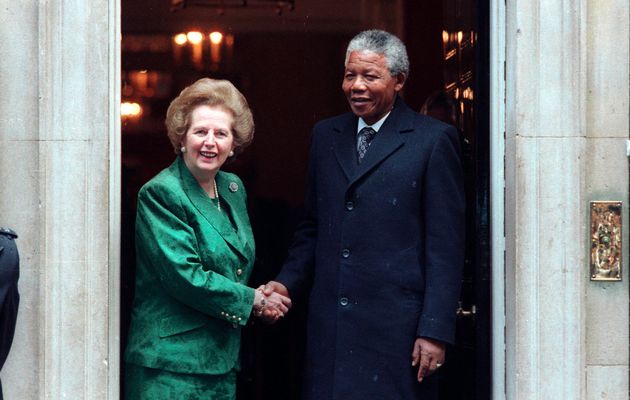 Die beklemtonings is van die AVP. Indien u hierdie toespraak van de Klerk met aandag lees, sal u sien hoe min die oordrag van mag met apartheid te maak gehad het.
Margaret Thatcher and the role she played in helping South Africa to achieve non-racial constitutional democracy FW de Klerk FW de Klerk Foundation [This article first appeared in the 16 April edition of the London Evening Standard] MARGARET THATCHER AND THE ROLE SHE PLAYED IN HELPING SOUTH AFRICA TO ACHIEVE NON-RACIAL CONSTITUTIONAL DEMOCRACY By FW de Klerk In her autobiography, Margaret Thatcher observed that few issues created so much scope for hypocrisy and hyperbole as did the question of apartheid during the 1980s. When considering Britain’s increasingly controversial relationship with South Africa she brought to bear all of the qualities that came to characterise her leadership. These included common sense, a clear understanding of Britain’s interests; a refusal to accept cant; and an iron will to proceed with policies that she believed in her heart to be right.
At no time did she give the slightest support for apartheid or for racial discrimination of any kind. She consistently urged South Africa to release Nelson Mandela and to move ahead with real transformation.
At the same time she realised that nothing would be achieved unless the international community also took into consideration the reasonable concerns and interests of white South Africans.
There were three prime concerns:
How could white South Africans be sure that their country would not go the same way as so many other African states that had held one-man, one-vote elections once - and then subsided into tyranny, corruption and conflict?
How would Afrikaners and other whites be able to retain the right to national self-determination that had been the central theme of their history? Afrikaners felt just as strongly about this right as any other nation. They had twice defended it against Britain, the mightiest imperial power of the time. One must remember that the Anglo-Boer War was Britain’s largest war between the Napoleonic War and the First World War - involving the deployment of more than 400
000 imperial troops.
The government was also deeply concerned about the influence of the South African Communist Party within the ANC Alliance. Throughout the 70s and the 80s virtually all the members of the ANC’s National Executive Committee were also members of the SACP. The SACP supported a classic two-phase revolution in which the national liberation movement - the ANC - would lead the way to national liberation. The SACP would then assume the vanguard role and move forward to the establishment of a communist state. This was not simply a question of 'reds under beds'. As late as September 1987 the South African Defence Force was involved in major conflict against Soviet and Cuban-led Angolan forces in southern Angola.
Margaret Thatcher also realised that the situation in South Africa was already evolving. PW Botha understood the need "to adapt or die". In 1983, coloured and Indian South Africans, were included together with whites, in a tricameral parliament. At the beginning of the 80s genuine trade union rights were extended to black workers. By 1986 more than 100 apartheid laws had been repealed and a year later the National Party accepted that black South Africans would have to be included in a common constitutional system with whites.
The only impact of these reforms on international opinion was the redoubling of demands for comprehensive sanctions. The agenda was no longer reform - it was for the transfer of power.
Margaret Thatcher understood the significance of these developments and also realised that the economic growth that sanctions was intended to reverse was in fact one of the most powerful forces for change. It was eroding apartheid far more effectively than sanctions could ever hope to.
All these factors convinced Prime Minister Thatcher of the folly of trying to cripple South Africa’s economy. She opposed the extension of sanctions with enormous courage and determination at successive meetings of the Commonwealth Heads of Government. She was invariably subjected to vitriolic and personal attacks, but, as always, she gave as good as she got: she pointed out that those calling loudest for sanctions - the frontline states - had no intention of cutting their own extensive economic ties with South Africa; many had human rights records worse than South Africa’s; and the people who were suffering most from sanctions were black South Africans.
Thatcher understood that sanctions have limited effect on states that believe that their very existence is at stake. She sensed that, more often than not, they spurred targeted societies to resist pressure for change. She knew that the implosion of South Africa would have very serious consequences for Britain: apart from threats to extensive investments in South Africa, Britain would probably have to accommodate hundreds of thousands of refugees and deal with the chaos that would be caused by the collapse of the continent’s leading economic power.
Margaret Thatcher’s efforts to ward off comprehensive sanctions were probably her greatest contribution to the subsequent successful constitutional evolution of South Africa. Had the Brian Mulroneys, Bob Hawkes and Robert Mugabes won the day and succeeded in further isolating South Africa, PW Botha - who was every bit as stubborn as Thatcher - might have brought down the shutters on reform and withdrawn South Africa into a grim, survivalist fortress.
As it is, she succeeded in holding the line until the end of the 80s when the geostrategic nature of the world changed. By the time I became leader of the National Party in February 1989, history had begun to open a window of opportunity for us: all sides had genuinely accepted the need for negotiations; the Namibian independence process had been successfully implemented and, most importantly, the threat posed by the Soviet Union - and the SACP - had collapsed.
Later in 1989 I visited London and informed Margaret Thatcher of my intention of embarking on fundamental constitutional transformation.
She assured me that she would do everything she could to help me.
During the subsequent negotiations, she gave me, Nelson Mandela and Mangosuthu Buthelezi unstinting support in our efforts to reach a peaceful and constitutional solution to the complex problems of our country.
For that, I shall remain deeply grateful to her. I am honoured that I have been invited to her funeral to help celebrate the memory of a truly great lady.