
Terwyl die ANC in Suid Afrika gereedmaak om sy “eenparty status” te versterk op 7 Mei 2014, maak die Skotte gereed om op 18 September vanjaar in ʼn referendum te stem om onafhanklik van Engeland, soewerein oor hulleself te regeer.
Dat so ‘n stap verreikende gevolge vir Engeland sal hê indien die referendumuitslag in die guns van die afskeiers beslis word, lei geen twyfel nie. Wat hierdie verwikkeling vir die Afrikanervolk van belang maak, is dat dit blyk of daar wêreldwyd ‘n gees van onafhanklikheid en soewereiniteit hom van volke en nasies meester maak.
Ons vryheidstryd wat regmatig gerig is en behoort te wees om weer politieke beheer oor ons land Suid Afrika te verkry, word gaandeweg versterk deur hierdie tendens wat oral besig is om sy kop uit te steek, veral in die lig van die indringing van volksvreemde elemente wat inbreuk maak op die inheemse volkere. Die negatiewe invloed van multikulturalisme, of kortweg integrasie, word al hoe meer erken as dié instrument by uitnemendheid wat deur die imperialiste aangewend word om beheer te verkry oor die energie-en-mineraalbronne van die wêreld. Die onderstaande berig is dus belangrik as dit saamgelees word met die ongurigheid wat oral ontstaan oor volksvermenging. Let egter op die argumente wat as afskrikmiddels opgewerp word.
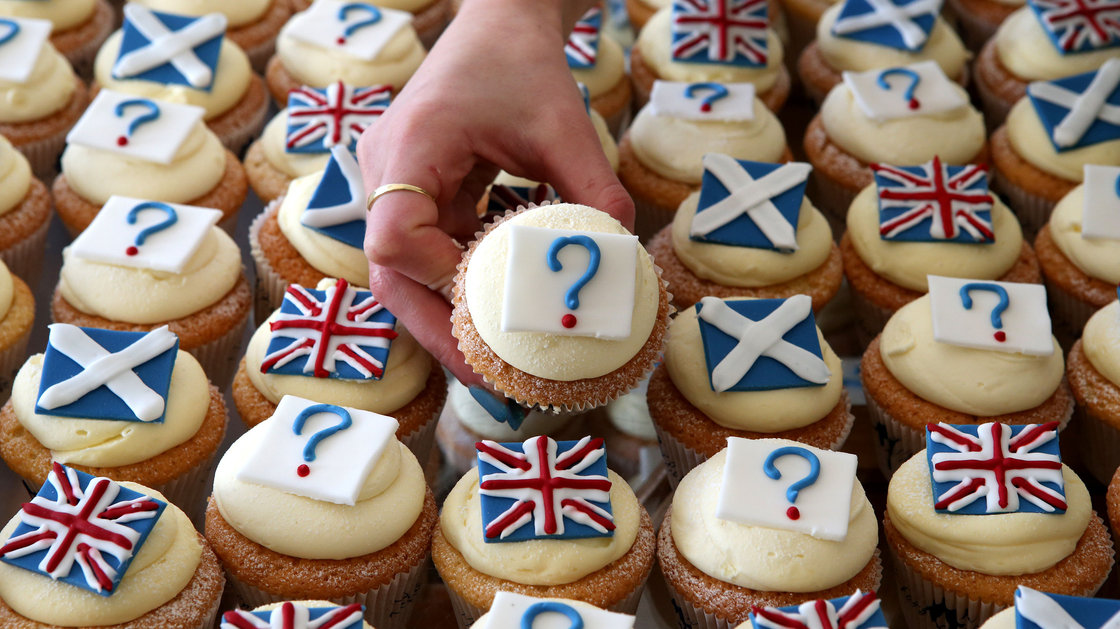 Will Scotland Go Independent? A Primer On The Secession Vote by Ari Shapiro March 05, 2014 5:00 AM ET
A bakery in Edinburgh recently launched an independence referendum poll using Yes, No and Undecided cupcakes.
Andrew Milligan/PA Photos/Landov
An intense campaign is underway for the future of the United Kingdom. On Sept. 18, the people of Scotland will vote on whether to become an independent country. Here are answers to a few key questions about the issue.
1. Why would Scotland want to leave the U.K.?
There are some reasons grounded in logic and others based in emotion.
Scotland wants more control over the oil and gas in the North Sea. Scots bristle at regulations from London. People in Scotland, who tend to be more liberal, feel that the conservative-led coalition government in London doesn't adequately represent them.
"We must become independent if we are to provide the economic and social advances that people who live here deserve to have," First Minister Alex Salmond tells his people.
But there are also reasons that have nothing to do with economics.
"It's a bit like getting a divorce, right?" says Monique Ebell of the National Institute for Economic and Social Research. "We know that divorce is financially painful. And I'm not saying that independence for Scotland necessarily would be. But even if it were to be financially painful, people still choose for noneconomic reasons to get a divorce."
The Two-Way
U.K. Warns Scotland: Vote To Secede, Lose Common Currency
Parallels
The Face Of The UK's Anti-EU Party
Political consultant Steve Morgan says Americans, of all people, should understand this. "You were once part of the empire. And you very sensibly broke away and got rid of all the trappings that go with it," he says. "Those of us who live here are stuck with it."
2. How is the British government trying to keep Scotland intact?
Prime Minister David Cameron's government is playing a good cop/bad cop game. The good cop is Cameron himself, talking about a "family of nations" that is "better off together."
The flip side of that message is that if Scotland breaks the family apart, chaos will ensue. That ominous warning comes from the bad cop, Chancellor George Osborne. He warns that an independent Scotland would have to abandon the British pound.
"The pound is one of the oldest and most successful currencies in the world. I want Scotland to keep the pound and the economic security that it brings," Osborne said in a recent speech.
3. Would an independent Scotland remain part of the European Union?
Not automatically. EU President Manuel Barroso says Scotland would have to wait in line and apply with other hopefuls. Current members of the European Union would have to vote. "It will be extremely difficult to get the approval of all the member states to have a new member coming from one member state," Barroso recently said.
Still, many economists believe that an independent Scotland, even if not a full EU member, could easily obtain a status similar to Switzerland, which has trade agreements that make it easy for the Swiss to do business with EU members.
4. How is Scotland's business community reacting?
Major businesses in Scotland have recently become more vocal about their concerns. Standard Life, the insurance firm based in Edinburgh, says it might leave Scotland if the independence vote passes. Royal Bank of Scotland warns that independence could cause real financial harm.
Ebell at the National Institute for Economic and Social Research has estimated that in an independent Scotland, "borrowing costs would be higher than those in the U.K. by 0.7 to 1.5 percentage points, which is fairly significant."
5. Will the referendum pass?
It's impossible to know six months before the vote. So far, polls have consistently shown votes for unity outnumbering those for independence by a significant margin. In the latest survey by the polling firm Ipsos MORI, 57 percent of respondents said they would vote against Scottish independence, while 32 percent said they would vote for it. Eleven percent were undecided