
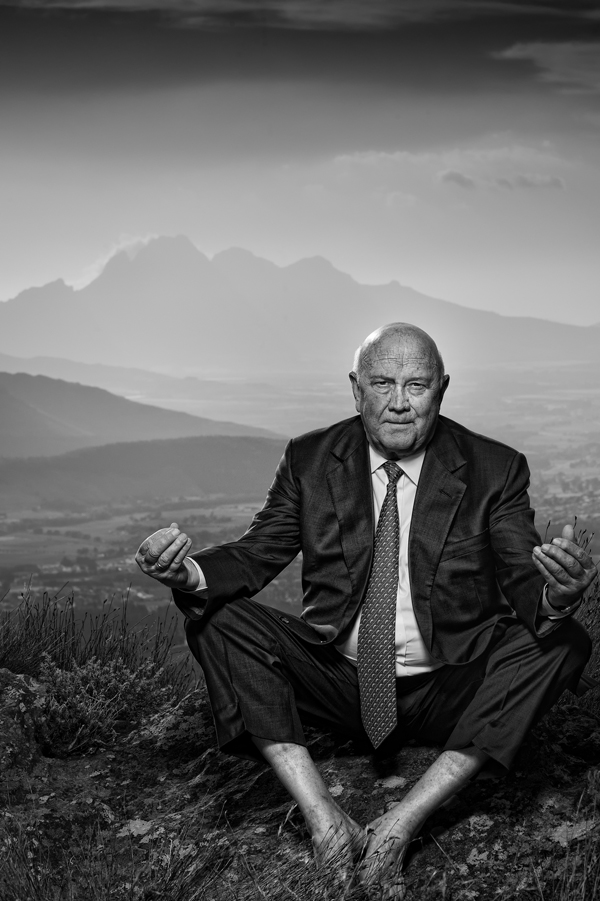
 Mr. de Klerk's broad formula acknowledges that he considers apartheid a dead-end street and that majority rule in some form is inevitable. But Mr. de Klerk has left no doubt, either, that he will strive to protect what the five million whites here have built up in the 350 years since the first settlers arrived, including their property rights and their right to control their own residential communities and schools.
Wat was dit wat de Klerk van uitgesproke konserwatiewe nasionalis laat verander het na liberalis wat sy eie volk verraai deur ontrou te handel met sy mandaat. Die AVP meet de Klerk aan die waarheid en werklikheid in ‘n poging om groter helderheid te verkry oor wat dit was wat hom gedryf het om selfs oneerlik op te tree ten einde sy politieke doel met die Afrikanervolk waarvan hy lid is, te bereik. Was hy van huisuit liberaal soos sy broer Willem, of het hy so geword onder die invloed van iemand anders of het hy bloot geswig onder druk? Ons kyk na verskeie menings en uiteindelik ook sy eie en meet dit dan aan uitspraak en optrede.
NEW YORK TIMES ARTICLES
Understanding de Klerk, Party Man With a Twist
By JOHN F. BURNS, Special to The New York Times
Published: April 01, 1990
Before F. W. de Klerk was chosen to succeed P. W. Botha as President, he was asked if he would be the Mikhail S. Gorbachev of South Africa, a loyal party man who overturns much that the party once held inviolable. Mr. de Klerk had a quick reply: ''The only thing Gorbachev and I have in common is this!'' he said, slapping the top of his head.
Three years later, there is more than baldness to support comparisons between the two leaders. Like President Gorbachev, President de Klerk has freed men previously vilified as traitors, declared past policies bankrupt and begun a process of change that has outraged party conservatives.
Also like Mr. Gorbachev, who has shown some of the old Kremlin reflexes in his recent actions in Lithuania, Mr. de Klerk has perplexed supporters and opponents alike, who wonder where he will call a halt to the scrapping of old policies.
While the South African leader has said he believes in an ''equal vote'' for blacks and whites and a system that eliminates racial discrimination, he has been purposefully vague about the details of the ''new South Africa'' that the Government has said it wants in place within five years.
Pragmatic Cast of Mind
Mr. de Klerk's broad formula acknowledges that he considers apartheid a dead-end street and that majority rule in some form is inevitable. But Mr. de Klerk has left no doubt, either, that he will strive to protect what the five million whites here have built up in the 350 years since the first settlers arrived, including their property rights and their right to control their own residential communities and schools.
While Nelson Mandela and other black leaders have said that Mr. de Klerk's vision appears to encompass limitations on black political authority that they could not accept, many South Africans who favor far-reaching political change say they believe that the real hope for the future may lie not in Mr. de Klerk's current pronouncements but in his probing, pragmatic cast of mind and an instinct to reach out for new solutions.
Mr. de Klerk's associates say those traits are allied to a profound religious commitment to ideals of justice that sets him apart from his predecessors.
The leaders of the National Party before Mr. de Klerk belonged to the main wing of the Dutch Reformed Church, a Calvinist body that lent such powerful theological backing to apartheid that it became known as ''the National Party at prayer.'' Mr. de Klerk is a member of the small Dopper church, a 19th-century breakaway that insisted on the separation of church and state, and, partly for that reason, avoided sanctioning the official racial doctrines.
'Dialogue Is God's Style'
While Mr. de Klerk makes little public show of his faith, his thinking on political matters has apparently been powerfully influenced by Dopper teachings, especially those taken from the New Testament. Meeting with Afrikaner church ministers in January, Mr. de Klerk traced his hopes for negotiations with black leaders to Dopper tenets about the need for believers to seek justice and reconciliation. According to the Rev. Pieter W. Bingle, Mr. de Klerk's Cape Town minister, the President put it simply. ''Dialogue is God's style,'' he said.
That belief in breaching differences through discussion appears to have converged with a politician's caution to persuade Mr. de Klerk that, for now at least, it is better not to draw blueprints of the new political system he will attempt to negotiate.
Officials close to Mr. de Klerk say the President will be flexible about matters that the National Party seemed set on as recently as September, when it won a bitterly contested election.
FW de Klerk and the Mindset of Treason
F.W de Klerk was once seen as being one of the most conservative in the NP government. What is it that changed him? How does one man, bordering on the extreme right wing in his party change to become one of the most liberal and hand the country over to Marxist terrorists? Did the change come out of his own accord or was he forced to change?
From history we see that there are several reasons why people become traitors or cross over to the other side. The main reasons are represented by the acronym M.I.C.E… Money, Ideology, Coercion and Ego, or any combination of the above. Of these, Ego is the most common one. Traitors are criminals of the worst kind, and something that criminals all share is their own greed and the belief that they will never be caught. They have strong narcissistic tendencies and an inherent belief that they are somehow special.
What was it that moved F.W. de Klerk to become one of the worst traitors of his people to date? Was it one of the above, or all of the above…or was it a specific combination? In this article I will explore whether F.W. de Klerk fits the criteria to be called a traitor as well as delve a bit deeper into life of this infamous Nobel laureate.
IDEOLOGY
EGO
MONEY
COERCION
The “I” for Ideology
Several authors as well as F.W. de Klerk’s own brother Wimpie de Klerk and F.W de Klerk himself, state that F.W. never really experienced a liberal Damascus conversion moment. With him it was a slow, gradual change. This is not entirely true. F.W. de Klerk did have a Damascus moment…well sort of.
To fully grasp his conversion, it is necessary to explore the ideology of F.W. de Klerk prior to his February 1990 speech. When we say he was conservative or religious, we need to define HOW conservative and HOW religious he actually was. For that, we need to digress slightly and explore the general beliefs and religious convictions of the Afrikaners in South Africa.
For the most part Afrikaners are staunch protestant people. Since the arrival of the first Dutch farmers at the Cape of Good Hope in 1652, they brought their Dutch Reformed Church (Nederduits Gereformeerde Kerk) NGK and Calvinistic religion with them. Highly educated ministers or “Dominees” were imported from the Netherlands. NG Kerk dominees study theology for seven years at university.
By 1834 when the Great Trek started on the Eastern Frontier in what is today the Eastern Cape, the Dutch Reformed Church (NGK) was one of the mightiest organizations in the Cape, and was opposed to the Great Trek. The Farmers who trekked and who later started their own Republics namely the ZAR (Transvaal) and the Orange Free State therefore started a new Church independent from the Dutch Reform Church or NGK. This church is known today as the “Hervormde Kerk” or “Reconstituted Church”. The Hervormde Kerk (HK) also imported their own Dominees from the Netherlands.
At the time there was a debate going on in the Netherlands on whether hymns should be sung in church together with Psalms or only Psalms. The argument was, “In God’s Church, only God’s word”. The argument was that hymns were sometimes of unknown and therefore dubious origins, and could have been inspired by Satan who urged a drunk to write a hymn in his drunken state. Actually they found that some of the hymns were in contradiction to the Calvinistic teachings, the Canons of Dort and the Belgic Confession.
A dominee called Dirk Postma arrived in the Boer Republic of the ZAR to take up service in the Hervormde Kerk, but upon hearing that he might have to sing Hymns in church, he broke away with 15 members and a short while later started a new Ultra Conservative church called the Gereformeerde Kerk or (GK) and enrolled 300 members. So at this stage there were three of these Dutch Reformed Churches. The Nederduits Gereformeerde Kerk (NGK) of the Cape, The Hervormde Church (HK) of the Transvaal and the Gereformeerde Kerk (GK), the Boer Church.
One of the founding fathers of the GK church was Boer President Paul Kruger himself. Together with his 15 founder brothers and 300 new members they founded the GK under a seringboom in Rustenburg in 1859. Paul Kruger was a deeply religious man. He also believed that the earth was flat and claimed that he only ever read one book in his life and that was the Bible. He said that he did not need any other books. He knew most of the Bible off by heart.(Maritin Meredith Diamonds, Gold and War. (New York:PublicAffairs),pg 76.)
The GK or “Dopper” Church is still known today as the “Boer Church”.
Why is the GK church known as the “Doppers”? The word comes from the Dutch name for a small bowl. When one places such a small bowl on someone’s head and shave off all the protruding hair, one ends up with a peculiar conservative and puritan hairstyle of the time. The Doppers calls the DRC or Nederduits Gereformeerde Kerk (NGK) members, “Gatjieponders”…the word comes from “Gat-Jappon” which literally translates to “Arse-coat” referring to the tuxedo style coats they used to wear 200 years ago. But I am digressing…
Nevertheless, all three churches – NGK, HK and GK – are sister churches and the dogma is basically the same, i.e. Calvinistic. The only difference is the singing of hymns in church. The GK only sings Psalms and what is called “Skrifberymings”, text out of the Bible rewritten to rhyme and given melodies.
Another difference is the belief of the Ultra Conservative “Dopper” Church, is that God personally intervenes in the lives of people, and that when one prays long and hard enough, God will show one the way…show one which course to take. They believe that one can get a calling from God. In Afrikaans it is called a “Roeping”. F.W. De Klerk was, and still is, such an Ultra Conservative Christian… a “Dopper”, a member of the Boer Church.
During his times of intense introspection, F.W. de Klerk also searched for such a sign from God, to show him the way, a calling to do something great. The sign eventually came in the form of his personal friend and Dopper Dominee, Pieter Bingle of Cape Town. De Klerk, his wife Marike and Pieter Bingle knew each other since their student days at the Potchefstroom University. Pieter Bingle was at the wedding of his son and testified in the murder trial following the murder of former First Lady Marike de Klerk. Pieter Bingle and F.W. De Klerk are also members of the same Afrikanerbond lodge (afdeling) , Leeuwenhof in Cape Town.
At the inauguration of F.W. de Klerk as State President, Dominee Pieter Bingle gave a sermon…His text was from Jeremiah 23 verse 16 and 22.
Jeremiah 23: 16
Thus says the LORD of hosts:
Do not listen to the words of the prophets who prophesy to you.
They make you worthless;
They speak a vision of their own heart,
Not from the mouth of the LORD.
Verse 22
But if they had stood in My counsel, And had caused My people to hear My words, Then they would have turned them from their evil way And from the evil of their doings.
In essence, Dominee Pieter Bingle told F.W. De Klerk to stop listening to the people and his advisers who were all “false prophets”. He told De Klerk that he was standing in the Council Chamber of the Lord, that he was an instrument of God. He told De Klerk that he who stands in the Council Chamber of the Lord will be aggressive enough to tackle problems and challenges fearlessly.
Further extracts from Pieter Bingle speech include:
New ways will have to be found where roads enter cul de sacs, or are worn out or cannot carry the heavy traffic. Excess baggage will be cast aside. Certain will stay and others will have to be discarded. Those stuck in the grooves of the past will find that besides the spelling, depth is the only difference between a groove and a grave.
Mr. de Klerk, as our new President, God is calling you to do his will. Today God calls you to serve as the President of South Africa. God’s commission is not to serve as the President of some of the people, but as the President of all the people of South Africa.
F.W. De Klerk was deeply moved by Pieter Bingle’s sermon. He was literally in tears. At a post inaugural meeting he told his friends and families that they should pray for him while the tears were flowing down his cheeks. He said that God called him to do a specific task…to save South Africa…To save all the people of South Africa. He said that he knew he would be rejected by his own people, but that he had to walk this road and that his friends and family should help him. He confessed that God had called him and that he could not ignore the call.
De Klerk, the narcissist, felt himself special…singled out by God Almighty to do this job…to commit the ultimate treason against his people.
From that day on, De Klerk knew what to do. God told him to hand over the country to a gang of Marxist terrorists.
Whilst De Klerk enjoyed his liberal Damascus moment, on the other side of the parliamentary benches, the Conservative party felt different. These people were also Christians who believed God told them to oppose De Klerk’s decisions such as Dr. Andries Treurnicht who was a Dutch Reform minister for 14 years himself and later became leader of the Conservative Party, the opposition of the National party.
But why was F.W. de Klerk in doubt to start off with? What cognitive dissonances were playing off in his mind at the time of his Bingle induced Damascus moment? Well, several things played a role. For that we need to go back to the mid 1980’s and the discussions between people at grill parties (Braais) a favorite past time of South Africans. We have to backtrack into the fears and doubts of the people of the time.
In 1985 president P.W. Botha scrapped the Mixed Marriages Act and the Immorality Act which outlawed interracial marriage and interracial sex. Since 1983 P.W. Botha split the Afrikaners down the middle with the HNP and CP on the right, and the NP and the PFP on the left. The PFP was run by a liberal Afrikaner called Dr. Van Zyl Slabbert. Inside the NP itself, one had three factions – Liberals (Verligtes), Moderates (Draadsitters), and Conservatives (Verkramptes).
Around the Braais one would find friends and family with the entire spectrum of political views debating religion and politics, of which few actually had any idea. The Afrikaners of the time were for the most part political ignoramuses. Their political believes were based on Black and White racial politics and the threat of Communism, which was from the Devil. Asked them what “Liberal” and “Conservative” meant, they probably would not know. Typical braai conversation between a liberal and a conservative Afrikaner and the liberal would ask the conservative would be:“OK, so you believe in Apartheid, but when you go to heaven, would there also be Apartheid in heaven? Does God have a heaven for blacks and another for whites, or how does it work? Or do you believe that only whites go to heaven? Do blacks also have souls or only whites? What about all those converted blacks out there who converted to Christianity?”
Another question would be, “OK, so you say you are so conservative… The laws have now changed. It is now possible for whites to marry or have sex with blacks…What are you going to do when your son or daughter comes home with a black man or a coloured woman?” So with these questions in the minds of white South Africans of the time let us consider the de Klerk family.
The De Klerk Family
When one thinks that F.W. de Klerk was Ultra Conservative then it is still nothing compared to Marike (Willemse) de Klerk, his first wife. She was an extremely benevolent person who helped the poor Afrikaners a lot, but she was even more conservative than F.W. De Klerk. Her father, Wilhelm Willemse, was an academic, writer and Professor of Social Pathology and Psychology at Pretoria University.
Nevertheless, the couple never had any children of their own. They adopted three children together – Jan, Willem, and Susan – whom they obviously brought up with their religious convictions and conservative values. Little Willem de Klerk, turned out to be the black sheep of the family.
He was about 18/19 at the time that P.W. Botha abolished the Immorality Act in 1985 that prohibited sex between whites and coloureds. He was also one of the first to take advantage of this new found freedom. F.W. de Klerk’s youngest son had a weakness for the coloured girls of Cape Town.
While he was a student at the Cape Technikon he met a young coloured lady that took his fancy called Erica Adams. Erica was the daughter of a Coloured politician namely Deon Adams of the Labour Party. They were madly and passionately in love and wanted to get married, but their engagement didn’t sit well with Marike at all. She resented the idea of coloured grandchildren, much less from the apple of her eye.
She told him, in no uncertain terms, that he was putting his entire father’s work in jeopardy and that would destroy South Africa if he continued the relationship. After two years of severe pressure from his mother, Willem finally ended the relationship with Erica. Instead, Willem went on to marry a white Afrikaner girl called Hermien Mostert, a former teacher with a senior post at Woolworths.
Nevertheless the marriage lasted four and a half years and the couple got divorced around the same time that F.W. de Klerk got divorced from Marike. During Willems marriage to Hermien, rumours started circling that he and a dark-haired woman frequented a popular restaurant in Kloofnek, Cape Town. Who was this mystery dark-haired woman? Her name was, Nicole Norodien – another coloured lady that Willem eventually married in Paarl in 2003.
As with Hermien, Willem started divorce proceedings with Nicole in 2009 (the case is still ongoing). This was after she had an affair with a Johannesburg Businessman, Ernest Lefebvre. During the divorce case she claimed that De Klerk was “unpredictable and aggressive” towards her, and that he is “emotionally and verbally abusive”. Norodien described him as “regularly intoxicated”, adding that he drank “excessive” amounts of alcohol and that he had been having an several affairs.
Nevertheless he had two children with Norodien and because of this, Norodien wanted the court to order De Klerk to pay her maintenance of R15 000 a month, as well as comprehensive medical aid cover, a car worth R300 000, a house of up to R2-million or R20 000 a month for accommodation and “household necessaries” worth R200 000. The question begs to be answered: Was Norodien right? Was Willem de Klerk now having another affair with another coloured woman? Yes.
Willem De Klerk, now 44 years old, has just (May 2011) settled out of court with another coloured woman named Desiré Joseph , a 27 year old midwife at the Tygerberg Hospital. She comes from the Boland town of Wellington where her parents own a furniture shop. Furthermore, she also claimed that he was the father of her child Ana-Wilmien, but Willem insisted on paternity tests – which proved he was indeed the father.
The end result today is that former President F.W. de Klerk now has three coloured grand-children. What white Afrikaners spoke about around braais happened to him. His son came home with a coloured woman (several in fact) and several grandchildren. How could he still morally justify Apartheid when his son was producing coloured grand children on a regular basis? F.W. de Klerk’s superior education as a lawyer, his conservative convictions and his Ultra Conservative religious beliefs all came to naught when his youngest boy came home with a coloured girl.
As a once Ultra Conservative politician it must have chewed F.W. de Klerk up inside. Although Willem was an adopted child, he was still raised in the De Klerk household. He attended church and Sunday school, graduated with a “Boere Matriek” called “Katkisasie”, accepted into the Gereformeerde Kerk, the Boer church, yet he still discarded all of those conservative upbringings and went for race mixing. Under Apartheid laws F.W. de Klerk’s son would have been in prison.
F.W. de Klerk had to make peace with this and that his grand-children would be coloureds. As such, his Ideology changed from Ultra Conservative to Liberal. A rare occurrence indeed, as normally it’s the other way around.
Summary
With de Klerk, it clear that the entire scope of MICE was used to get De Klerk to capitulate and commit treason. His sins were covered up into the finest detail. The public was duped. The F.W. de Klerk that we saw on television was a tall clean shaven intelligent man always with a smile on his face. The people were taken in by him. He was the new broom, and boy was he sweeping clean…getting rid of all those cob-webs of the old Apartheid era. The real F.W. de Klerk was a different man altogether.
Today F.W. de Klerk is fully aware of the fact that white South Africans and other minorities consider him a traitor. In August 2010 F.W. de Klerk was interviewed by Murray La Vita of Beeld and F.W. said that the name “traitor” doesn’t bother him. The world acknowledged it after all when he received second prize at the Nobel prize ceremony, next to ex-terrorist Mandela.
FEINT & MARGIN
COMMENTS BY SONNY
Is dit die aller antwoord? Die AVP dink nie so nie. Wat van de Klerk se besoeke op koste van die State Department van Amerika aan daardie imperialistiese moondheid? Wat van die invloed van die Britte in Rhodesie deur middel van Lord Carrington? Die Winds of Change van MacMillan en John Vorster se verraad teen Ian Smith? Dan is daar nog die geheime Broederbond dokument. Nee, laat ons eers al die punte met mekaar verbind voor ons ‘n finale gevolgtrekking maak. Wat egter intussen vasstaan is die feit dat F.W. de Klerk instrumenteel was in die grootste dilemma waarin die Afrikanervolk in sy ganse geskiedenis gedompel is. Kan ons hierdie sessie afsluit met nog ‘n belangrike vraag? Wat was ons eie aandeel in hierdie gemors?